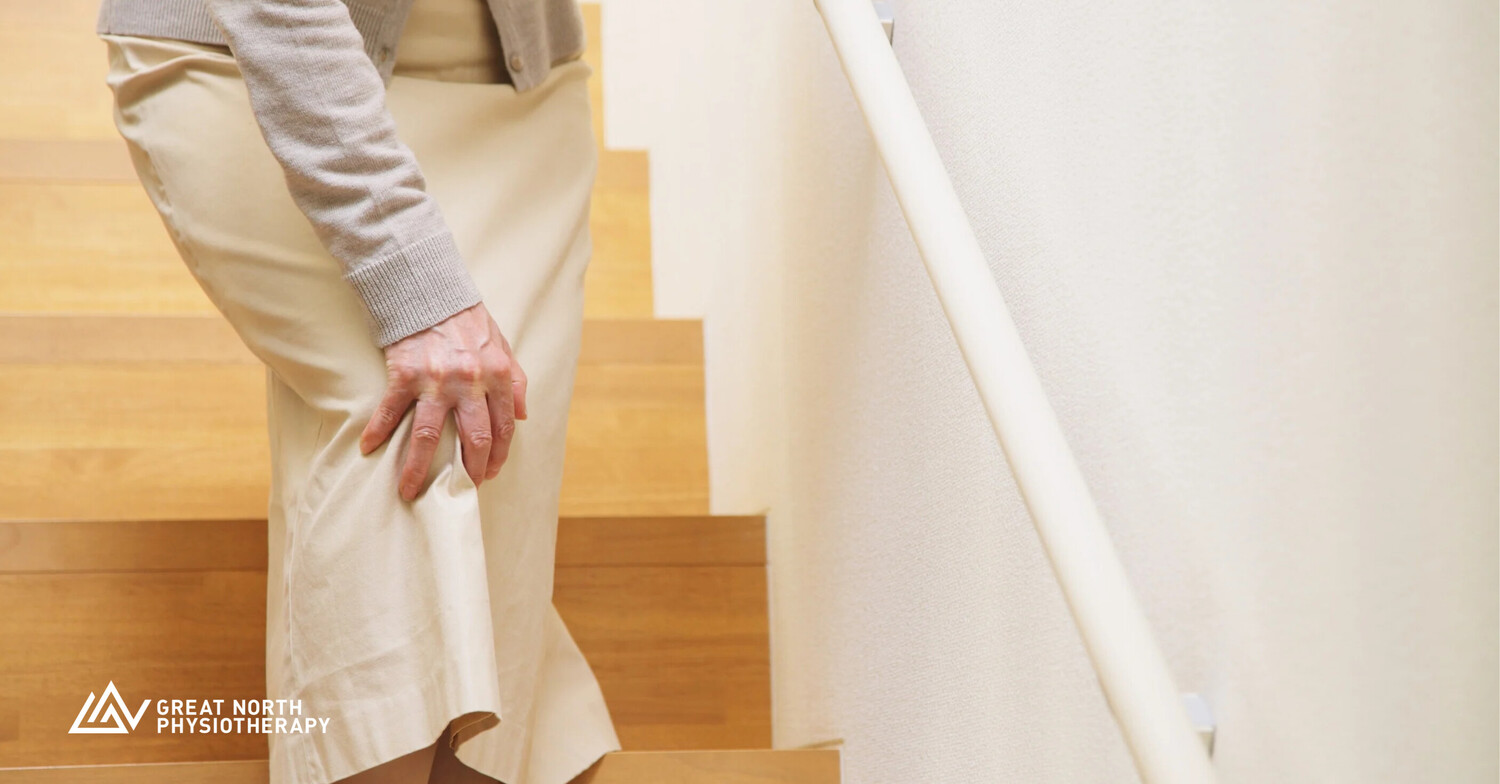
You're getting up from your chair after sitting for a while when you hear a clicking sound coming from your knee. Maybe you've been gardening in a deep squat and notice some cracking as you stand back up. Or maybe you're doing your usual workout and suddenly notice your knees are making more noise than usual.
Sound familiar? What's causing all that clicking and cracking, and should you be concerned?
Knee cracking is very common and, in many cases, is completely harmless. A study found that 99% of knees make some noise (McCoy et al., 1987). However, if the noise is accompanied by pain, swelling, stiffness, or an acute injury, it may be more concerning.
WHAT CAUSES YOUR KNEE TO CRACK?
Gas Changes Within the Joint
One of the more common causes of painless joint cracking is cavitation. This results from small amounts of gas that naturally exist in the fluid inside your joints. When you move a joint, the pressure inside it changes. Sometimes, the joint surfaces separate quickly, allowing a small gas-filled space or bubble to form. This can create the popping or cracking sound you hear.
You might notice that once a joint pops, you can't immediately make it pop again, even if you keep moving it. That's because the joint needs some time for the gases to redistribute before another pop can occur. This is generally harmless and doesn't mean your knee is being damaged.
Tissue Sliding Theory
Sometimes, the clicking or snapping sensation comes from soft tissues moving around the knee. The noise may be associated with increased local friction, where two surfaces slide against each other. Increased friction may result from more static positions. This noise may occur after prolonged sitting or when regaining movement after immobilization. The more you move, the more the joint warms, and synovial fluid helps lubricate the joint, reducing joint noise.
Patellofemoral Crepitus
Another common cause of knee cracking is called crepitus. Crepitus refers to grinding, crunching, or crackling sensations that can occur when moving a joint. In the knee, this often involves the patellofemoral joint, where the kneecap moves along the groove at the front of the thigh bone.
You may notice this when:
● Walking up or down stairs
● Squatting
● Getting up from a chair
● Kneeling
● Straightening your knee after sitting for a long time
Knee crepitus is not necessarily a sign of damage. In a 2018 study (de Oliveira et al.), among women with patellofemoral pain, findings demonstrated that the presence of crepitus did not influence physical activity level and pain; however, it can play a role in creating a potential fear response. Many people experience clicking or grinding without having pain or any significant underlying joint problem.
Osteoarthritis and Changes to the Joint
As we age, the cartilage that supports the knee joint can gradually change. Osteoarthritis involves changes to the cartilage and other structures within the joint. These changes can sometimes contribute to grinding, clicking, or creaking sensations during movement. Crepitus may predict symptomatic OA but is not directly associated with the onset of arthritis or the need for a knee replacement down the road (Pazzinatto et al., 2018).
WHEN SHOULD YOU BE CONCERNED ABOUT YOUR KNEE CRACKING?
The most important distinction is whether other symptoms accompany your knee cracking.
Usually less concerning:
● Painless clicking or popping
● Cracking when squatting or standing up
● Occasional noises without swelling
● No restriction in movement or daily activities
Worth having assessed:
● Cracking accompanied by pain
● Recurrent swelling
● A feeling that the knee is giving way
● Locking or difficulty fully straightening the knee
● Persistent stiffness or reduced mobility
● Pain following a twisting injury or sudden pop
● If you cannot bear weight, have a significantly swollen knee after an injury, or have a hot, red knee accompanied by fever, seek prompt medical assessment
SHOULD YOU STOP EXERCISING IF YOUR KNEE CRACKS?
Not necessarily! If your knee makes noises but isn't affecting your movement, you generally don't need to stop exercising. In fact, regular physical activity and progressive strengthening help maintain healthy joints. Activities such as walking, cycling, swimming, and resistance training can all help maintain knee strength and function.
The key is to find an appropriate activity level and gradually build your exercise tolerance.
SHOULD YOU BE CONCERNED ABOUT YOUR CRACKING?
The good news is that knee cracking is often completely normal. Painless clicking, popping, and grinding are common and do not necessarily indicate joint damage or arthritis.
However, when cracking is accompanied by pain, swelling, stiffness, or instability, it is worth having your knee assessed to identify what may be contributing to your symptoms.
Remember: It's not necessarily the noise that matters, but how your knee feels and functions.
Experiencing knee pain or discomfort? Our physiotherapy team can help identify the cause of your symptoms and develop a treatment plan to get you moving comfortably again.
Want to learn more? Book an appointment with Julia Glaves at Great North Physiotherapy in St. Catharines or Niagara-on-the-Lake. Schedule online at www.greatnorthphysio.ca or call 289-606-0966 to speak with our team.
Always consult a healthcare professional before starting a new exercise routine and prioritize consistency and good form for optimal benefits.
REFERENCES
1. McCoy, G. F., McCrea, J. D., Beverland, D. E., Kernohan, W. G., & Mollan, R. A. (1987). Vibration arthrography as a diagnostic aid in diseases of the knee. A preliminary report. The Journal of Bone and Joint Surgery. British volume, 69(2), 288–293. https://doi.org/10.1302/0301-620X.69B2.3818762
2. de Oliveira Silva, D., Pazzinatto, M. F., Priore, L. B. D., Ferreira, A. S., Briani, R. V., Ferrari, D., Bazett-Jones, D., & Azevedo, F. M. (2018). Knee crepitus is prevalent in women with patellofemoral pain but is not related to function, physical activity, or pain. Physical therapy in sport: official journal of the Association of Chartered Physiotherapists in Sports Medicine, 33, 7–11. https://doi.org/10.1016/j.ptsp.2018.06.002
3. Pazzinatto, M.F., de Oliveira Silva, D., de Azevedo, F. M., & Pappas, E. (2018). Knee crepitus is not associated with the occurrence of total knee replacement in knee osteoarthritis: a longitudinal study with data from the Osteoarthritis Initiative. Brazilian Journal of Physical Therapy. 23(4), 329-336. https://doi.org/10.1016/j.bjpt.2018.09.009