.png)

Experiencing a new pain or discomfort during activities you enjoy, or even during everyday tasks, can leave you wondering what’s going on. Often, people respond in one of two ways: they either stop moving completely or push through the pain, hoping it will resolve on its own.
In reality, recovery often lies somewhere in the middle ground between these two approaches.
Let’s talk about why that balance matters, what to consider when dealing with an injury, and how physiotherapy can help guide the process.
Rest in the early stages of an injury can be beneficial. It gives your body time to respond and begin the healing process, especially in cases of acute injury, where a specific moment affected your function. However, there is a point where too much rest can have undesirable effects on healing tissues. Prolonged inactivity may not be helpful, particularly if symptoms have been present for weeks or months.
Many people are familiar with the traditional RICE method for managing acute injuries: Rest, Ice, Compression, Elevation. More recently, this concept has evolved into the PEACE & LOVE approach.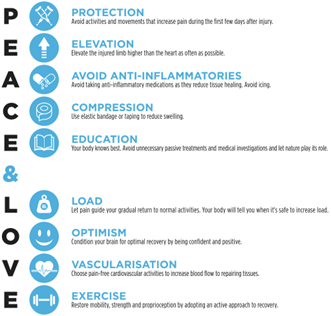
In the acute phase, the focus is on PEACE: Protection, Elevation, Avoid anti-inflammatories, Compression, Education.
The goal during this stage is to allow the body’s natural inflammatory and healing processes to occur. Rest often plays a larger role here, and in some cases, immobilization (such as a cast or walking boot) or an assistive device may be recommended by a medical professional.
As healing progresses, the focus shifts to LOVE: Load, Optimism, Vascularization, and Exercise.
For some injuries, this phase begins sooner than others, but this is where the concept of relative rest becomes important. Rather than avoiding movement entirely, the goal is to reintroduce appropriate activities to support healing gradually.
Prolonged inactivity can lead to muscle weakness, joint stiffness, slower tissue healing, and sometimes persistent pain. We know that tissues such as tendons, muscles, and even bones (when it is safe to do so) respond well to the right types of movement and progressive loading.
If your goal is to return to activities at home, at the gym, or your local rec centre, it’s important to maintain activation of the injured area when appropriate, or to strengthen the surrounding muscles that support it. Having a structured plan can help you safely return to the things you enjoy.
On the other hand, doing too much too soon (or performing the wrong type of activity) can aggravate symptoms and delay recovery. This is where proper guidance from a physiotherapist can make a big difference.
Physiotherapists are trained to understand how injuries affect the body and how to restore movement and strength safely. Rather than simply advising you to “rest,” they develop a personalized plan that supports healing while keeping you active. This often includes a combination of targeted exercise, pain management strategies, injury prevention, and education.
Many people wait weeks or even months before seeking help for pain. During that time, the body may develop compensations or movement restrictions that can complicate the problem.
Seeing a physiotherapist earlier can help:
● Prevent small injuries from becoming chronic problems
● Reduce recovery time
● Help you stay safely active during the healing process
Whether your injury is acute, subacute, or something you’ve been managing longer than you would care to admit, working with a physiotherapist can help you develop a plan to get you back on track.
Want to learn more? Book an appointment with Julia Glaves at Great North Physiotherapy in Niagara-on-the-Lake. Schedule online at www.greatnorthphysio.ca or call 289-606-0966 to speak with our team.
Always consult a healthcare professional before starting a new exercise routine and prioritize consistency and good form for optimal benefits.
RFERENCES
1. Dubois, B., & Esculier, J. F. (2020). Soft-tissue injuries simply need PEACE and LOVE. British Journal of Sports Medicine, 54(2), 72–73. https://doi.org/10.1136/bjsports-2019-101253
2. Khan, K.M., Scott, A. (2009). Mechanotherapy: how physical therapists’ prescription of exercise promotes tissue repair. British Journal of Sports Medicine 43, 247-252.
.png)
.jpg)
.jpg)
.jpg)